Sunday, February 28, 2016

Flow--

flickr photo by muha... https://flickr.com/photos/muha/1213836424
shared under a Creative Commons (BY) license
“Contrary to what we usually believe, moments like these, the best moments in our lives, are not the passive, receptive, relaxing times—although such experiences can also be enjoyable, if we have worked hard to attain them. The best moments usually occur when a person’s body or mind is stretched to its limits in a voluntary effort to accomplish something difficult and worthwhile. Optimal experience is thus something that we make happen. For a child, it could be placing with trembling fingers the last block on a tower she has built, higher than any she has built so far; for a swimmer, it could be trying to beat his own record; for a violinist, mastering an intricate musical passage. For each person there are thousands of opportunities, challenges to expand ourselves.” ― Mihaly Csikszentmihalyi, Flow: The Psychology of Optimal Experience

Flow--
Very honestly, not a concept I'd given much thought to before
Unless I was referencing water in a river or from a faucet

 And so, when Anne articulately made a case for flow as a critical element in blended learning in a conversation on her blog I was really interested!

Me: You highlighted “flow” and I’m interested what additional thoughts you have on that? strategies/processes that may enable that?

Anne: I would say that flow is THE critical factor that determines whether your online learning activities are deemed a success or not. In itself it is not sufficient but if you can create that feeling amongst participants that they can’t wait to log on to see what the next installment is then you have succeeded. Of course this leads to a great sense of loss and mourning once the course comes to an end but that is a necessary negative I would say.

Me: You’ve made a case for flow–I’m really interested
As a designer how do we/how can we design for flow? What do you feel enables that in online spaces? I’d love to hear your take on it–

Anne:  I feel that promoting flow is not just one thing but a whole range of factors which includes engaging tasks that can be personalised, timely responses from the facilitator so that learners feel heard (this counts for a huge amount, even for adults) and modelling in the right places. You can’t/mustn’t model all responses but well chosen model responses as a prompt from the tutor make it easy for learners to follow without getting confused or mislead as to what is required. And finally, though it comes first, are those silly low stakes tasks that come at the beginning that enable learners to test out the learning platform and to get to know each other and build up trust that can later be used to work together. I call them silly tasks because, if not well presented, adults especially can feel that they are silly, but they are vital building blocks for what comes later. Building flow is a human process that I strongly feel cannot be automated. eg timely tutor response – here you have to know when an early response is a good idea ‘pour encourager les autres‘ or when it is better to let the discussion unfold a little amongst the participants before a tutor responds.
As I've been thinking on her response, what strikes me, is the complexity, the nuance, the multifaceted approach, the art, and the need for pattern sensing and responding that characterize an environment that enables flow. I'm wondering if adding inquiry learning, student centered learning creates an additional dimension for flow in blended learning? And I'm thinking that in any design for blended learning, there should be/needs to be an intentional mindfulness of enhancing flow.

 I've been pondering this from a facilitator's perspective and I wonder how it looks and feels different to a learner in a learner driven environment? Are there personal attributes that support immersion in optimal experiences? What results when someone tries to stretch past their limit?

 Thanks to Anne, I've more thinking to do.

Monday, February 22, 2016

Work in Progress

flickr photo by Kevan https://flickr.com/photos/kevandotorg/6229660191 shared under a Creative Commons (BY) license

My life has been and continues to be 
A work in progress

Whether it be 
Cleaning the house
Gardening
Learning
Designing learning environments/experiences
or 
Any other of a myriad of focus

At this very moment, Work in Progress extends primarily to the new PLPNetwork Blended Learning eCourse.

And while I've attempted to design a learner centered asynchronous experience that's fluid and filled with choices and have put that design onto a platform to set a trajectory for learning that is open for editing based on learner paths (sensing this week that "feedback" is not exactly in the right week and now regretting such a linear unfolding and wondering what I can learn/do to alleviate some of that), the synchronous weekly webinars continue to be a huge work in progress.

Each week we have a focus. And our time together in the webinar is about digger deeper into that focus. And I want that digging to not be about what I've brought to this experience but rather what is best for the good of our collective learning.  Given that, each week I suggest a path and ask if there are suggestions or burning questions or pieces we should ignore and to date everyone agrees to just move forward--

I've given thought to an edcamp type of webinar-- and I carefully watch each week for interests and passions we might bring into our time together.  And very honestly about this time each week, I wonder if I should panic because I'm unsure of the scaffolding/processes. 

And that's occurring especially this week as I've uncovered new possible processes that might really be instrumental in deepening and clarifying thinking.  Liberating Structures--  I've been a Nancy White follower for many years now and she has been sharing on her blog.  And I've been torn for the last number of days between adapting The User Experience Fishbowl as we explore formative assessment more deeply or go with a protocol I've used before What comes up for you?  I think there may be value in each. And given that I really want to encourage and model the importance of voice and choice, what may happen is that I'll ask the group to weigh options and decide what they'd like to do.

So I am reminding myself--
learner centered
inquiry based
is always
and will continue to be
A WORK IN PROGRESS

And that's ok--  right?


Sunday, February 14, 2016

Learning Postures Emerging

They are becoming even more curious, inquisitive, tentative, collaborative and reflective-- the co-learners in the current PLP Blended Learning eCourse.  And it's difficult, if not impossible, to sit on my hands and not celebrate that for it was many years ago that I wrote on this blog what's below; now wanting to highlight again what I sense as the importance of that stance. And wondering what else you might add to this thinking?


Stand up straight; watch your posture. Do you remember that or is it a product of my generation? I heard it lots when I was young; even had to practice walking with a book on my head—my folks really stressed it and I never had good posture to their chagrin—

In the classroom, I did think about posture-- from a different perspective, always searching for a more accomplished practice. Initially, my posture was upright, in the front of the class, talking, giving information, and telling. My “teaching posture” evolved -- I was often sitting, in the back or with a group of students or a student, sometimes prodding, questioning, and listening. Yet I’ve noticed that my initial posture still is in vogue in many classrooms.
And as I’ve been involved in various learning communities more recently, I’ve noticed that teachers seem to be so comfortable in “teaching postures” which mirror my initial one, that it is translated into their professional learning too. I’m really feeling, and I could be wrong, that negatively impacts moving forward toward a global 21st century practice. So lately I’ve been spending time pondering on a learning posture-- what it looks like, what it sounds like, and how to help teachers adopt one.

I’m wondering, after reading and thinking, might a “learning posture” be characterized as:

Curious and Inquisitive
So I am curious- what do you think? Should we be focusing on a different conversation than the one we are having? Should we be re-envisioning education in ways that are radically different? And if so- How do we move from talking to doing? Or is that important? --Sheryl Nussbaum-Beach
What does this new design look like? What are the big questions regarding learning, teaching and schooling that we need to begin to address? How will the roles of elementary schools and high schools begin to evolve? How will we address the divide issues that these opportunities outside of school create? And how do we personally plan for these changes as learners, parents and teachers? --Will Richardson
My focus for the next while will be an experiment as well as a creative outlet. I’ve created a space to publish fictional narratives where my true identity is intentionally obscured. I want to see what happens to the questions of digital identity, social structures and relationships, and network dynamics when the identity of the author is replaced with a fictional character – and the readers are aware that the "I" and "me" in the blog entries refer to someone who does not actually exist. –Mike Bogle

Tentative and Unfinished
Examples of “process as text” are recordings of classroom conversations, considered temporary and fleeting, that become something more than a passing conversation when they exist as video or audio recordings. These types of texts stay fixed – we can’t really go back and change the flow of a conversation – but our finished products, when published digitally, are easily and perhaps even secretly editable and revisable after publication. So we’re able to fix the temporary and fiddle with the permanent. That seems interesting and worthy of further exploration. –Bud theTeacher
That’s all I’ll say for now. I hope to revisit these ideas on occasion. I also hope you’ll help me think through them. – Jon Becker
Much to continue to mull over here: some ideas to tinker with, and some practices to encourage, but still very much a set of “conjectures and dilemmas” (Bruner) to keep exploring. – Gardner Campbell

Collaborative and Participatory
I was part of an interesting discussion on Twitter Friday night and I wanted to share it here, as well as add a few final thoughts. Participants that I reference are Bud Hunt,Brian CrosbyDean Shareski, Anne Van MeterBarbara Barreda, and Karen Fasimpaur. Thanks to all of you for helping me think through these ideas. – Karl Fisch

Reflective
That’s one of those really concise shift statements that makes me bend my own frame a bit. I think too often I fall into looking at these tools and wonder what they can add to our classrooms and our teaching when the real question is how can our classrooms and teaching add capacity to the tools. – Will Richardson

When I began mulling this over I had not anticipated that I would be including a sense of unfinished business; yet I have begun to feel that is particularly important. I’m not yet satisfied that I’ve captured the essence of a “learning posture” yet am feeling pretty strongly that it’s worth pursuing, especially avenues for helping teachers with an awareness of their posture and how that may affect not only their own professional learning but also that of others.

Might it not be possible that such a focus may open doors for many to possibilities for learning not yet imagined?

Sunday, January 03, 2016

My one word-- Possibility


"If I were to wish for anything, I should not wish for wealth and power, but for the passionate sense of the potential, for the eye which, ever young and ardent, sees the possible."  - Soren Kierkegaard
Not a new word for me--
Renewing again my commitment to possibility--

Open
To all that I encounter
Embracing each moment 
Willing to follow paths where they'll take me

The possibilities for Gus' and my life together
The possibilities to continue to make some difference
The possibilities yet to be discovered

flickr photo by christopherdale http://flickr.com/photos/christopherdale/7617487586 shared under a Creative Commons (BY-NC-ND) license

Wednesday, December 30, 2015

Gwen


Only when you drink from the river of silence shall you indeed sing.
And when you have reached the mountain top, then you shall begin to climb.
And when the earth shall claim your limbs, then shall you truly dance.
On Death, Kahlil Gibran

She was kind, she was firm, she cared, she wanted more for the students she served.
She was a principal and a friend.

She welcomed me to Jane Addams Business Careers Center in 1988 with a invitation to lunch in the Executive Grill that the students run-- a kindness and thoughtfulness that I'd not experienced with any previous principal (nor did I encounter at any other time in my career). 

I had applied to teach at Jame Addams, as what might be called today, an intervention specialist for students who had been labeled learning disabled, many of whom were enrolled in the culinary arts program. I supported students in their vocational programs and provided instruction in academic areas as needed.  And I had recently discovered the potential of computers for learning. 

Ms. Lynton cared about and supported all students. Initially when she learned how I hoped to infuse technology into learning (think Bank Street Writer and As Easy As), she made sure my students could be scheduled into the computer lab. Then, she arranged for computers for my classroom. And when we were stifling from the heat in our classroom (the air conditioning didn't work and the windows were sealed shut), she shared the fan from her office with us. David had asked permission to go to her office to request a fan and came back with hers.

She led an initiative to transform learning at Jane Addams that held great promise. In my role as adviser to students as we planned, our collaborations led to a friendship I cherished. Unfortunately, LATTICE never came to fruition as Gwen fell victim to a stroke and then retired.

We remained friends throughout the years--  she visiting in our home and I in hers. More recently, we've connected through Christmas cards each year.

When I received the email titled Gwen last week, memories of her, of her smile, of her thoughtfulness and selflessness flooded over me and remain with me.

A special woman, a special educator-- my life has been the richer for our connecting-- thank you Gwen.  

May you truly dance -- now free.


flickr photo by davidhuiphoto http://flickr.com/photos/davidhuiphoto/3649721215 shared under a Creative Commons (BY) license

Tuesday, December 22, 2015

Constraints and Possibilities

Creative Commons Licensed
Designing for learning
And realizing in the process

How coming up against a constraint (thanks to Amy Musone for sharing the importance of that term)
Is tough
Is frustrating
And can uncover insights into learning that became somehow buried a bit

As I considered the learning environment for the new Blended Learning eCourse I'm designing and facilitating for Powerful Learning Practice, I had what I thought was a terrific idea.  During the week that we explored questioning and feedback more deeply, I'd use forums for that purpose on the Edublogs class blog that I'd created.

Knowing little to nothing, like always, I jumped in confident that I could tinker and figure out how to make it work.  There was documentation with clear instructions. I activated the bbpress plugin and figured I was on my way!  Thinking I was on a roll and anxious to see how the forum would display, I created a forum, a topic within that forum and a reply and embedded it on a page on the blog only to find that the contents didn't display.  It clearly said there was a topic with a link to click which in turn provided an option to reply ---  but with no content--  sigh!!!

So I tried it in another browser.  I searched in troubleshooting forums. I changed themes as suggested in one forum.  And I tinkered, I left it to try again another day, I deleted everything I did, I reread the documentation, I tried creating again, I searched the forums, and I played and tinkered to no avail.  After some 12 hours of that, I knew I'd hit a wall.  I didn't know enough, I didn't have enough foundational knowledge for what I wanted to do, and I didn't have time to continue.

Two epiphanies--
I had moved too far from my zone of comfort
Excerpted from https://thecurriculumcorner.wordpress.com/2015/01/02/danielsons-fft-3b-questioning-discussion/ with permission
I can't say I was panicked, yet I did not have enough background to make progress, to ward off frustration.

As I thought of all I was designing for learning for the ecourse, I realized that  many co-learners might experience similar frustrations when faced with creating their own dashboards, or repurposing a tool for deepening learning; I have always tried to be sensitive of that and this experience will support me in being even more mindful of that.

Second, and perhaps just as if not more important--  I began thinking more deeply on what technology really best suited the goal of engaging in more meaningful conversations by making use of more accomplished questioning and descriptive feedback. The conversations I envisioned can occur in a forum, or on a message board or in the comment feature of blogs.  And yet, strangely, I had discounted that last option; strangely because I had incorporated blogging as a potentially powerful medium for blended learning.  It makes good sense to continue to examine more fully the possibilities that blogging and connected learning offer.

So I'm switching gears, so to speak, realizing my current constraint--  we'll be having our discussions in the comments of co-learners' blogs.

And the bbpress forums-- I haven't let that go--  something keeps nagging at me--  what if it's just one little thing you didn't realize--  that nagging may compel my future learning that will start with foundational knowledge on which I can grow my troubleshooting skills.  Just imagining the possibilities--

Friday, November 27, 2015

Gifted and Thankful

Strikingly beautiful
This gift
Out of the blue
In a Walmart parking lot
From a perfect stranger
With a wide smile saying
I want to pay it forward
Happy Thanksgiving--

More than touched by her kindness and generosity
Filled with gratitude

Renewing and reminding us for the second time in one day of the goodness of the human spirit

The first being the gift of a "Doo-wop" CD from Gus'  gracious and thoughtful physical therapist, having heard him sing to that same music in a previous session.

In these times of horrific violence, hate and fear mongering, these acts of kindness are extraordinarily sweet.

Saturday, October 03, 2015

We can do better--

flickr photo shared by honikum 
I couldn't help it--
Tears in my eyes--
A pain in my heart--

For the third time in a month, a small child (this one just 5 months old riding with mom in the car to the grocery store) was killed in a drive by shooting in Cleveland, just 30 miles west of here and our home for many years.

3 children in one month-  one 3 years old, one 5 years old and now one 5 months old-- all victims of driveby shootings.

The Cleveland mayor saying "enough is enough" and the Chief of Police crying as he reported what happened saying  "marches are not enough, we need to do something."

Two days in a row--
first President Obama at the federal level about the horrific tragedy in Oregon and now the Mayor on the loss of life of these 3 little ones.

And I wonder-- is this who we, as a nation, want to be?

I know solutions to these senseless tragedies are complex and multifaceted and will take a focus and determination as yet unrealized. And I believe there is a path to a better tomorrow.

What if--
Everyone of us advocated for a better system of background checks, more funds and programs for the mentally ill, mentors and initiatives for urban areas where gangs are prevalent to reduce gang violence,  and new endeavors to eliminate childhood poverty across the nation?

What if--
Everyone of us carefully vetted the federal, state and local officials we voted for to learn their plans for decreasing the violence across the country that has permeated both urban and rural areas? And what if our votes aligned with that vetting?

What if  --
Everyone of us watched out for those we sense are fragile-- stepped out to be more inclusive; stepped back with vitriolic language; and stepped back out to report our concerns when signs of depression, instability arise in others in our face to face lives and on social media ?

What if--
Everyone of us drew a circle that pulled all in?

Outwitted-- E. MarkhamHe drew a circle that shut me out--
Heretic, a rebel, a thing to flout.
But Love and I had the wit to win:
We drew a circle that took him in!

Tuesday, March 24, 2015

Lack of limits


Going through some of the many papers still saved from more than 35 years of learning and teaching--
And running across this--
From my cubicle in 2001--

Unfortunately now not able to locate the source-
Education in the 21st century will be defined by its lack of limits,
by the idea that we can virtually take our students around the world,
back in time, out among the stars,
and in between the atoms.

Pretty powerful--
Seeing pockets of that--
And wishing for so many more--

Monday, February 09, 2015

Discover, Dream, and Design

creative commons licensed (BY-NC-ND) flickr photo by ChimpLearnGood: http://flickr.com/photos/alphachimpstudio/3806097249
Sunday afternoon I saw the title of this post. The connected educator movement is failing and we're all to blame. That caught my attention-- alot. And I did something I rarely do, I jumped into the comments mainly because the judgment for failure is based on metrics from Twitter and I've strong feelings about....

Very honestly -- I don't know Daniel, the author, and I don't think I've ever been an "edtech" person (whatever that is). Even as a "resource teacher" in the instructional technology office of a very large urban district, I was the one with a Masters degree in curriculum; I was the least "tech" person in the office.  How did I get the job?-- I recognized the power and potential of technology for learning and connecting- opening new windows onto a world for so many. And in all the professional development I have designed and facilitated --learning, collaboration and connecting was the focus. So I guess that was the reason I jumped in, and perhaps not very cogently, as the contents of that post touched the core of my passion.

Here's my comment:

I guess I'm surprised that a focus on Twitter is the metric for determining the failure of educators connecting. What about educators connected through online communities of practice, those connected through the ongoing K12Online conference, and those connected through Connected Educator month, not to mention those connected in ongoing projects with colleagues and classrooms around the world? 
From one who sees connecting as all about connecting with people (see the intro quote in chapter one about human networks in The Connected Educator: Learning and Leading in the Digital Age), connecting with context made possible through the affordances of technology-- the possibilities for systemic change we'd like to see happens when we can engage in deep, meaningful and messy collegial conversations. In my humble opinion, a prerequisite for that to happen is a relationship built on trust. Although growing and nurturing trust occurs on Twitter, I think more than 140 characters are needed to immerse in the kinds of discussions that deepen relationships that in turn enable those conversations necessary for change. 
I'm likely one of those you've mentioned who you see as positive to a fault. The angst I feel about certain named "reform" efforts hurts my soul yet I know that our words create our reality and we grow towards that on which we focus and so I'll continue to maintain that positive focus. I'm old; I've been blessed to see and experience the power of connectedness made possible only by the affordances of technology. And I've a deep belief in the importance of relationships in teaching and learning (Barth). Without them (face to face and in online spaces) and without context, how can we even think of engaging in conversations with others?
I'm wondering if an "us" vs "we" mentality contributes to the creation of a wall of resistance? What if all our efforts were about "we". What if our "we" efforts focused on what's working, what's the best of learning in everyone's classroom? And then together, we ask how can "we" grow our collective practice to improve learning for all of our students? And as all voices contribute, we leverage what we've learned from others across the globe into the conversation?

I guess I was hoping that perhaps I was articulating an inclusive approach, an avenue to develop a more collective accomplished connected practice. And I guess I'm advocating for this from a lens not often taken in the "edtech" community, that of appreciative inquiry.

Daniel was generous to reply
Twitter is simply a metric, but I see it as helpful. Tom's insights also are helpful, but again are also just a signal. They obviously don't show the whole picture, but they're a helpful insight. The Twitter numbers are kind of shocking because of the promise that Twitter held for the rest of education in the past few years. Last year it made this Top 100 Tools for education. http://c4lpt.co.uk/top100tools... Clearly, the folks responding to that survey have their own bias. 
Others have reached out to me over the past 24 hours. I have questions like this: "What about all the connections that go on in Schoology and Edmodo: that's "connected education," correct?" 
Sure, there's also places like K12 Online Conference, which is probably a microcosm even compared to the Twitter numbers. We can't judge this by looking through our own glasses, or we get it wrong. Schoology certainly doesn't have a million teachers on it. Looking through Edmodo's communities, they're connecting going on there, but how does that compare to 6.9 million other educators? Microcosms.
We keep looking at things from our own experience, our own schools perspective. What is working for you, is most likely not working for the school down the street. In order to bring the other 6.9 million along, we need to start communicating in a way that empathizes with the non-connected educator.
 
If a tech tool can eventually bring a physical connection (or a virtual connection that goes beyond Skype or Hangouts)- that's more powerful. How do we make that happen?
Obviously I did a very poor job of sharing my perspective-- at least that's how it feels to me--

Perhaps I've tunnel vision--- yet there is an incredible amount of research around appreciative inquiry as an effective approach to systemic change.

I just so wish I was better able to articulate it's potential--

Monday, December 08, 2014

New lenses


Back from a visit to the optometrist--
Where an order was placed for new lenses--
Computer glasses -- "these will help you see more clearly at your computer"
Leaving the progressives for seeing at other times.

In front of my computer
Scanning #ccourses in Feedly,
Progressive Lenses -- wait-- what a coincidence

As Simon Ensor was optimistically and eloquently looking to the future through his progressive lenses
I am of the opinion that as new networked culture emerges we will inevitably need to reflect on the lenses which are appropriate. ...
I am optimistic that new emerging conditions will enable new lenses which will allow us to reconsider issues of dominance, of transactions between us.
My new lenses offer greater clarity on what's to come enabling, through #ccourses reading, a novice understanding of possibilities for growing a truly authentic digital identity. When Bill Benzon suggested
The message is quite clear: build your own. No, not necessarily from scratch – whatever that means. But at least install your own Word Press instance, and even have your students do it – much as participants in this workshop had to set up their own blogs.
And that has, in fact, been a running theme throughout the workshop. Whatever course you are teaching or will be teaching, it is important to engage with the technology in an active way. If we treat the web as a big media server and passively consume text, videos, and music, we will become slaves of the web. We have to actively engage with the web, and setting up a blog is a good way to begin.
and referenced
Simon Thomson’s vision of establishing an online identity in kindergarten, maintaining it into and through primary and secondary school, on into higher ed, and out through final graduation into life in general.
with a link and description of Known

I began to think of pieces of my identity sprinkled around the web, much not readily available today --
And the import of the potential for me even now and  especially today's learners --

These new lenses enabling an exciting perspective that compels more thinking and exploration--


Tuesday, December 02, 2014

Trust--

source of quote
"Learning is always a risk. It means, quite literally, opening ourselves to new ideas, new ways of thinking."
Vulnerability
Trust as a foundation for learning

I've attempted to create an environment based on that in the eCourse I facilitate around coaching in online spaces.  We wonder together, we co-create together, and we play together. And I've written about the importance of that trust and relationship building, especially in online spaces, for learning.

And my focus has been on relationships--

With Jesse Stommel's post, Trust, Agency, and Connected Learning, my thinking has been stretched with his thoughts on agency and honesty about the learning environment -- their contribution to trust and connected learning.

As I'm sitting here thinking on agency, I think I may have approached it through a different lens with a request for each co-learner to develop a learning pledge and with additional requests to reflect in online spaces of their own choosing. I am going to have to spend more time clarifying this for myself.

I do have to say that one of Jesse's statements about trust in the environment truly jumped out for me.


(And yes, I do love Painting with Words!)
That syllabus I had to create for the university in order for co-learners to earn graduate credit--  sigh---     As I rethink that "trajectory map", there will be a sticky with the quote always visible.

"Trust literacies"-- I want to latch onto that thought "trust literacies". I may be stretching the author's intent --
yet it seems to me that this may be an important trust literacy--
"none of us can teach or learn freely in an environment without first getting our bearings — without first looking around and thinking about where we are and why we’re there."
That--
And others--
Honesty, agency, relationships--

Am I onto something here that will strengthen, enrich, and set a foundation for even deeper connected learning?   I'm feeling so--


Monday, December 01, 2014

From the periphery--

creative commons licensed ( BY-NC-SA ) flickr photo shared by potomo
As much as I encourage sharing and contributing in the online communities in which I coach and lead-- understanding the potential of connected learning

As many times as I've shared this video from the Co-Learning Unit -- Obvious to You Amazing to Others


You'd think I'd be walking my talk
Especially with the unit on co-learning which I find compelling
And yet--- I've been on periphery-- reading--
Curating great nuggets of insight from the posts of others.

Knowing at this point that I'll never compose the epic post that has played out in my mind daily--

I'm opting for and committing to a number of shorter posts on co-learning to clarify my thinking so I'll have them to come back to.

With Howard Rheingold's definition of co learning,
In my definition, co-learning involves a re-orientation of each learner from purely individual acquisition of knowledge toward a process of sharing learning and sense-making with each other learner — peer-learning and peer-teaching at the same time. Co-learning also means that the teachers learn along with and from other learners in the same course.  
my mind went back to 2001 when I had the privilege of a year's planning for a new career pathway program for high schoolers wanting to become teachers.  A piece from Thomas Carroll profoundly influenced my thinking and was key in my designing (Carroll, T. G. (2000). If we didn't have the schools we have today, would we create the schools we have today? Contemporary Issues in Technology and Teacher Education [Online serial], 1 (1). Available: http://www.citejournal.org/vol1/iss1/currentissues/general/article1.htm ), particularly the images and excerpts quoted below.
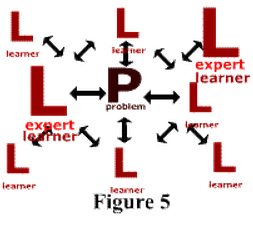
Once we move the teacher—as an expert learner—into the learning activity we begin modeling the learning process with the students. They are all learning together. And as I have said, once we reach this point, it’s not useful to distinguish between students and teachers, because they are all learning. Who is teaching and who is learning? They are all learning.     Figure 4 helps us start thinking about everyone in this dynamic field as a learner.   I represent each individual with an “L” to indicate that they are learners, and that the role of each individual in this activity is learning.  We need to get rid of the circle and enable them to be learners in an open learning environment (see Figure 5).  One of the large “L’s” in the diagram is the expert learner, the more senior, experienced learner, the person we pay to continue to structure these learning activities, but the person who is also constantly learning more and modeling the learning process, as opposed to the teaching process.Once we have defined these individuals as learners, and once we have taken those boundaries away, we can actually add more learners to the equation.
I'm wondering how Carroll may have influenced the vision of #ccourses  -- if indeed others sense the connection. 

It's been an important one for me as I dig more deeply into the thinking of  #ccourses co-learners in the posts to follow.

Monday, September 29, 2014

Spaghetti sauce and the Connected Coaching eCourse--a new perspective

Photo Credit
I thought it was the best -- it was delicious-- it worked-- it was good--
3 years ago
when I wrote
The homemade spaghetti sauce last week was rich, flavorful-- just downright extraordinary.
I attribute most of that to the quality of the ingredients-- something about organic farm fresh tomatoes, new onions, fresh organo, real garlic, and a touch of hot sauce to add a bit of a zing. Yet I've used those same ingredients before and the sauce never had the unique flavor of this batch. There must be something to the love, to the passion that becomes part of the process. No longer a strict recipe follower when I'm putting together a dish I've made before, there is the possibility of an extra large clove of garlic, maybe dried oregano-- always evolving, responding to conditions at hand.
And then recently
a neighbor shared some she had made
and
it was time to consider
how to take the best of what was and create the best of what could be
and this time it seems as it's the addition of 2 cloves and a bay leaf--

In that post of years ago,
the sauce and the Connected Coaching pilot were the focus of my thinking--

Now,
the sauce with its added spices --
compelling--
And as it simmered, my thoughts focused on the Connected Coaching eCourse I facilitate, in its 3 or 4th iteration. Learners have been transparent with their excitement at the possibilities and I have been, I fear, a bit too satisfied, lulled into some sense of complacency. Should know better at this age.  Time and time again, each group developed meaningful relationships to their surprise. And my hope, that others might see the potential of the appreciative inquiry approach (that I view as a real game changer in education) in which they are immersed in the eCourse and adopt that stance in coaching, has come to fruition more than I could ever imagine.

And I attributed much of it to our purposeful collective building of trust through a variety of activities and to my continued thinking on adult learning and assessment , influenced significantly by Sheryl Nussbaum-Beach, Dean Shareski, Dave Cormier, Cathy Davidson and Anne Fox who introduced me to the research on heutagogy. I thought I had developed a Lani remix that enabled self directed learning.   I thought I was on to something.

As one who thought she put learners at the forefront-- In 2013, the co learners in one section of the course objected to the term "learning contract":
Although I hope that everyone in the course will always view the potential for change in our Connected Coaching model and see the possibilities throughout the process, I am never sure how our journey will play out for so many reasons. Since I've requested that each co learner create his/her own learning contract, since I've stressed our time together is about their following their personal interests under the umbrella of coaching in online spaces-- it has been my fervent hope that that request and some possible paths outlined mapped in the MentorMob playlists and weekly overviews set the stage for organic, messy, linked learning increasing the likelihood of trips characterized by detours, side trips and loop backs.  
For this trek, the discussion and angst around the learning contracts which are shared with the entire group and for which many request feedback went deep with serious questions around its purpose and value. Initially, this request (the learning contract and it is a request as are all the learning opportunities) is open with few parameters or introduction. When the questions arose  I added a resource on heutagogy that speaks to the importance of self governed learning, the contracts filled the discussion thread as did comments supporting each others efforts and various paths towards personal goals emerged. We were on our way-- together. And I had my first big aha moment! When I had adapted the learning contract for the eCourse, I had not given thought(and should have) to the connotations of "contract". When Doris  suggested she'd prefer to call her contract a learning pledge-- my brain stopped for a moment-- and then realized the implications remembering what a difference one word can make and how much more aligned pledge is to the community building of the eCourse and to the Connected Coaching model! Next trip-- learning pledge is it!

And has been since---

The "learning pledges" developed, we do a KWL and a collective wondering as the course begins and I'm feeling we're delving into each learner's purpose. (My feelings on the eCourse were much the same as the ones I had had for the spaghetti sauce.) And as we progress through each week, I suggest essential questions.

Let's stop there    ---enter Connected Courses
and Michael Wesch's and Gardner Campbell's videos --


my making connections to my context--
knowing I know "my why" of the course-- to provide the opportunity to experience the potential of a strength based inquiry to improve practice and the world of education--

and my questions. WAIT-- my questions
and realizing that my questions become the focus-- really
despite my intention that learners engage in their own "why", to follow their passions

It's time -- to take the best of what works and create the best of what could be--
Just as the goodness of the spaghetti sauce grew and benefited from additional perspectives and the added spices--
So should the eCourse with my intended focus on the next iteration with an additional, more sustained focus on the "why" of the co learners.

Can I share fully developed thoughts on what that will look like, sound like? Not yet-- a work in progress-- additional thoughts on this welcomed!

Thursday, September 18, 2014

Why I teach--


This photo from 2002, my last year in a face to face classroom --
Juniors and seniors in high school aspiring to become teachers--
Presenting at the State of Ohio Technology Conference--

The seniors shared their 2 week summer experience for elementary students that they had designed, planned and taught the previous summer.

The juniors held a live video conference session as part of an ongoing collaboration with Josh Baron from Marist College who was supporting their own planning for their upcoming summer camp.

And I--  I was in the audience experiencing the joy that comes from observing learners spreading their wings and flying, being
in the “helping folks realize they can do things they didn't think they could” business. --Bud Hunt (Thanks so much Bud for helping me articulate why I teach)
In the same business in online spaces since that photo-- with educators and adult learners-- opening doors to possibilities.

Why I teach---


Monday, September 15, 2014

The "on ramp" --

Photo credit


An extraordinary "on ramp" --
already vast learning landscapes--
The pre-course week of Connected Courses

Inviting--
The "voice" of the course calls to me The tone is warm, light; that in itself so warm and inviting. Word choice implies trust in me as a learner, positive intent, integrity.  For example -- guidelines --

captured from 
The community guidelines  -- expectations for honest conversations with a commitment to collegial learning on a number of levels.
"Trust that people are always doing the best they can." 
i the biggest surprise to see and at the same time heartwarming as it aligns with the strength based coaching I facilitate currently.

The language in how to join the syndication flow  -- "We know you're excited but"-- had me smiling as I followed the expert instructions.

And guidelines again for blogging like a champion with the striking images especially the "now what" four legged friend at the end make it clear these were not rules but there for everyone to learn from.

Inclusive--
In addition, those invitations are inclusive-- specific instructions for those more novice, additional resources for others more technically competent and assurances that this is not to be about mastery of all content but rather, as Howard Rheingold tweeted

And Mia declared "a guilt-free learning zone"
Informal and Creative--
Full evidence here as Embed, Click and Link lead the second Blog Talk with Howard Rheingold taking a "learning posture" in many instances. The laughter, Link's tools, the hats, the talk of playing, the thorough enjoyment and the potential for learning-- at the end of the session, I begin to consider for the first time the possibilities of my own tinkering; although I know some very very basic html, I'd not ever given a thought to creating such a learning hub believing I lacked the capacity. Thanks much to the "brothers" for opening my thinking.


Personalized--
The potential for options, choice in blogging platform, dipping into the flow make this learning journey feel very personalized.

The facilitators' comments on posts in the pre course establish a real sense that each co learner's voice is important to what will come.

I just have to say-- that Howard Rheingold comment on my first post three hours after it was published was really exciting (continues to be, smiling very very broadly) as I've long been fan of his writing, his ideas, his approach to learning. And just a few hours later, Kim Jaxon left a comment too; I'll learn much from her as learners in her course participate in Connected Courses too.

Instructive and thought provoking --
New learning landscapes and this is just the "on ramp"--

The principles of connected learning -- The interactive graphic, new to me, visually summarizes learning and design principles parallels my aspirations for the current facilitation and community work in which I'm engaged.

As I read Howard Rheingold's Under the hood, where technology pedagogy and power meet I make connections to the TPACK framework that informs my practice, realizing that my stepping out to "look under the hood" can engender more fully the true collaboration and co learning possibilities.
"The technologies of publishing and discourse that become available to those who are willing to look under the hood and try some tinkering can be used as powerful amplifiers of co-learning. The objective is not to teach mastery of web media, but to make it easier for students to take responsibility for their own learning and enough co-responsibility for their classmates’ learning that a real learning community can emerge."
And then in Reflection conversation co learning this!
"Reflecting on texts is a path to understanding by an individual learner, but when a group of learners reflect in public, they provide a rich field for conversations about the material. Debates. Conjectures. Contrapositives. Analysis. Conversations can lead to co-learning, when other elements — trust, shared purpose, fun, reciprocity, serendipity, lead learners, skilled facilitation — combine to influence groups of learners to be co-responsible for each other’s learning."
There it is, eloquently articulated, a description of our recent Connected Coaching Strategies 2 with one exception-- "in public". I now imagine the possibilities had that been the case.

Reading and rereading Maha Bali's Process for Connecting,  and wondering and thinking on her image and my experiences (a shared purpose/vision enabled connections)-- reflecting deeply on the essential component of trust in the process, the need for trust in self, and for reciprocity. Her post causing me to explore my own thoughts more deeply, still.

Why this matters to me --
On a personal quest to become more inviting, even more inclusive in facilitating connected learning in online spaces, I'm soaking up the modeling and demonstrating to adopt/adapt for the K12 environment in which I facilitate and co learn.

Wanting to stretch my thinking and doing, aspiring to better articulate my thinking, and yes, wanting to exercise this old brain in the best of ways--

Connected courses modeling, demonstrating the best of ramps onto learning - I'm more than pumped for the next leg of this connected learning journey.

Tuesday, September 09, 2014

It's settled-- Connected Courses it is!

photo credit
Decisions, decisions
They seem more difficult to make as the years roll by

The waning gardens call to me-- greatly in need of tender care
As does the new AI Studio -- so full of possibility
And the ramp up to Connected Courses has truly captured my attention

Which direction? or can it be, should it be directions?

Yearning
for the opportunity to be in the open air and digging and cutting back and thinking already about next spring--

for digging deeper into appreciative inquiry with AI practitioners from across the globe--

for learning as compelling as I experienced in CCK08  and sensing the enormous potential  in #ccourses 

I'm not in higher ed although I do design and facilitate professional learning for educators; with other commitments I'm afraid I won't be able to be as active a learner as I would like--

Excuses. Really.

Especially when I read  Why Would I Take a Higher-Ed Connected Course? from a middle school teacher

And even more with Mia Zamora's  Connected Courses: Towards a guilt-free learning zone…. 
I for one want everyone to know that their own learning pathway (whatever that may turn out to be) is perfect.  Such is the particular affordance of truly open learning.  In my experience, magical things happen when we let ourselves unlearn the criterion of institutionalized conventions.  So let’s drop the guilt instinct, and just learn by self-design (interest-driven lurking is the foundation!). What “open” really means is that YOU are the true center of the learning.
What a wonderful invitation!

and Alan Levine's  thoughtful comment to that post:
Everyone is on a spectrum of participation they chose, change- its constantly evolving. There are many avenues of participation that do not require being loud and visible online.
photo credit
Those pushed me to the edge yet should I hang back?

What's surprising to me is I feel just like I did prior to CCK08 -- it must be like the anticipation of the first day of school for those many 35 years-- so full of possibilities and yet underneath the surface serious tensions -- oh the uncertainty. Can I? Should I? Do I?

Silly.

Decision-- direction--
I’m jumping in again, almost jumping--sensing some pretty special opportunities and possibilities (there's that word again) for extending learning and deepening understanding-- disregarding the nagging “what have I got myself into this time”.

It’s just time to let the learning begin!!

Wednesday, August 20, 2014

Connected Coaches earn certification

Connected Coaching eCourse
Note: Cross posted from Powerful Learning Practice blog.

What happens when a group of passioned Connected Coaches from around the world come together for six weeks to reflect upon and improve their practice?

They become poster children for global collaboration as they dialogue asynchronously and juggle time zones across the U.S., Canada, Denmark, Hong Kong and Australia to collaborate synchronously. They dig even more deeply into the complexity of appreciative inquiry, cognitive coaching, trustbuilding, and protocols to become more accomplished in the craft of coaching. And as they do, they co create:

Coaching Tips and Tricks


  5 Card Flickr Stories about coaching  

 Coaching Metaphors


Brainstorming areas of interest, they self select into 2 groups to conduct mini action research-- one group around a growth mindset and coaching and the other, protocols that support design thinking. In a final celebration webinar, they present their process and all they've learned-- enriching our collective coaching wisdom.

 From the design thinking group


And the group exploring growth mindset and coaching


It was, as Shelley mentioned, "six weeks of extraordinary commitment"!

And with that commitment, that exceptional learning, that action research, Powerful Learning Practice is proud to announce it's first group of certified Connected Coaches, coaches who have adopted the dispositions of and met the standards for a Connected Coach.
Amy Musone
Anne Fox 
Cathy Beach 
David Baker
Dawn Imada Chan 
Fiona Turner 
Jennifer Bloomingdale
Linda Nitsche 
Mark Carbone
Shelley Labiosa 
Viv Hall

Congratulations! We are delighted to acknowledge your certification as PLP Connected Coaches.

Sunday, August 17, 2014

Are we listening?

A voice from the past--- more than 50 years ago--
Injustice anywhere is a threat to justice everywhere. We are caught in an inescapable network of mutuality, tied in a single garment of destiny. Whatever affects one directly, affects all indirectly. Never again can we afford to live with the narrow, provincial "outside agitator" idea. Anyone who lives inside the United States can never be considered an outsider anywhere within its bounds.
You may well ask: "Why direct action? Why sit ins, marches and so forth? Isn't negotiation a better path?" You are quite right in calling for negotiation. Indeed, this is the very purpose of direct action. Nonviolent direct action seeks to create such a crisis and foster such a tension that a community which has constantly refused to negotiate is forced to confront the issue. It seeks so to dramatize the issue that it can no longer be ignored. My citing the creation of tension as part of the work of the nonviolent resister may sound rather shocking. But I must confess that I am not afraid of the word "tension." I have earnestly opposed violent tension, but there is a type of constructive, nonviolent tension which is necessary for growth. Just as Socrates felt that it was necessary to create a tension in the mind so that individuals could rise from the bondage of myths and half truths to the unfettered realm of creative analysis and objective appraisal, so must we see the need for nonviolent gadflies to create the kind of tension in society that will help men rise from the dark depths of prejudice and racism to the majestic heights of understanding and brotherhood. The purpose of our direct action program is to create a situation so crisis packed that it will inevitably open the door to negotiation. I therefore concur with you in your call for negotiation.  
But when you have seen vicious mobs lynch your mothers and fathers at will and drown your sisters and brothers at whim; when you have seen hate filled policemen curse, kick and even kill your black brothers and sisters; when you see the vast majority of your twenty million Negro brothers smothering in an airtight cage of poverty in the midst of an affluent society; when you suddenly find your tongue twisted and your speech stammering as you seek to explain to your six year old daughter why she can't go to the public amusement park that has just been advertised on television, and see tears welling up in her eyes when she is told that Funtown is closed to colored children, and see ominous clouds of inferiority beginning to form in her little mental sky, and see her beginning to distort her personality by developing an unconscious bitterness toward white people; when you have to concoct an answer for a five year old son who is asking: "Daddy, why do white people treat colored people so mean?"; when you take a cross county drive and find it necessary to sleep night after night in the uncomfortable corners of your automobile because no motel will accept you; when you are humiliated day in and day out by nagging signs reading "white" and "colored"; when your first name becomes "nigger," your middle name becomes "boy" (however old you are) and your last name becomes "John," and your wife and mother are never given the respected title "Mrs."; when you are harried by day and haunted by night by the fact that you are a Negro, living constantly at tiptoe stance, never quite knowing what to expect next, and are plagued with inner fears and outer resentments; when you are forever fighting a degenerating sense of "nobodiness"--then you will understand why we find it difficult to wait.  
There comes a time when the cup of endurance runs over, and men are no longer willing to be plunged into the abyss of despair. I hope, sirs, you can understand our legitimate and unavoidable impatience.
we who engage in nonviolent direct action are not the creators of tension. We merely bring to the surface the hidden tension that is already alive. We bring it out in the open, where it can be seen and dealt with. Like a boil that can never be cured so long as it is covered up but must be opened with all its ugliness to the natural medicines of air and light, injustice must be exposed, with all the tension its exposure creates, to the light of human conscience and the air of national opinion before it can be cured.
 
So let him march; let him make prayer pilgrimages to the city hall; let him go on freedom rides -and try to understand why he must do so. If his repressed emotions are not released in nonviolent ways, they will seek expression through violence; this is not a threat but a fact of history. So I have not said to my people: "Get rid of your discontent." Rather, I have tried to say that this normal and healthy discontent can be channeled into the creative outlet of nonviolent direct action. 
Let us all hope that the dark clouds of racial prejudice will soon pass away and the deep fog of misunderstanding will be lifted from our fear drenched communities, and in some not too distant tomorrow the radiant stars of love and brotherhood will shine over our great nation with all their scintillating beauty. 
16 April 1963, Excerpts from Letter from a Birmingham Jail
Martin Luther King, Jr.
 A voice from the present


Are we listening?