Showing posts with label learning. Show all posts

Tuesday, December 22, 2015

Constraints and Possibilities

Creative Commons Licensed
Designing for learning
And realizing in the process

How coming up against a constraint (thanks to Amy Musone for sharing the importance of that term)
Is tough
Is frustrating
And can uncover insights into learning that became somehow buried a bit

As I considered the learning environment for the new Blended Learning eCourse I'm designing and facilitating for Powerful Learning Practice, I had what I thought was a terrific idea.  During the week that we explored questioning and feedback more deeply, I'd use forums for that purpose on the Edublogs class blog that I'd created.

Knowing little to nothing, like always, I jumped in confident that I could tinker and figure out how to make it work.  There was documentation with clear instructions. I activated the bbpress plugin and figured I was on my way!  Thinking I was on a roll and anxious to see how the forum would display, I created a forum, a topic within that forum and a reply and embedded it on a page on the blog only to find that the contents didn't display.  It clearly said there was a topic with a link to click which in turn provided an option to reply ---  but with no content--  sigh!!!

So I tried it in another browser.  I searched in troubleshooting forums. I changed themes as suggested in one forum.  And I tinkered, I left it to try again another day, I deleted everything I did, I reread the documentation, I tried creating again, I searched the forums, and I played and tinkered to no avail.  After some 12 hours of that, I knew I'd hit a wall.  I didn't know enough, I didn't have enough foundational knowledge for what I wanted to do, and I didn't have time to continue.

Two epiphanies--
I had moved too far from my zone of comfort
Excerpted from https://thecurriculumcorner.wordpress.com/2015/01/02/danielsons-fft-3b-questioning-discussion/ with permission
I can't say I was panicked, yet I did not have enough background to make progress, to ward off frustration.

As I thought of all I was designing for learning for the ecourse, I realized that  many co-learners might experience similar frustrations when faced with creating their own dashboards, or repurposing a tool for deepening learning; I have always tried to be sensitive of that and this experience will support me in being even more mindful of that.

Second, and perhaps just as if not more important--  I began thinking more deeply on what technology really best suited the goal of engaging in more meaningful conversations by making use of more accomplished questioning and descriptive feedback. The conversations I envisioned can occur in a forum, or on a message board or in the comment feature of blogs.  And yet, strangely, I had discounted that last option; strangely because I had incorporated blogging as a potentially powerful medium for blended learning.  It makes good sense to continue to examine more fully the possibilities that blogging and connected learning offer.

So I'm switching gears, so to speak, realizing my current constraint--  we'll be having our discussions in the comments of co-learners' blogs.

And the bbpress forums-- I haven't let that go--  something keeps nagging at me--  what if it's just one little thing you didn't realize--  that nagging may compel my future learning that will start with foundational knowledge on which I can grow my troubleshooting skills.  Just imagining the possibilities--

Tuesday, March 24, 2015

Lack of limits


Going through some of the many papers still saved from more than 35 years of learning and teaching--
And running across this--
From my cubicle in 2001--

Unfortunately now not able to locate the source-
Education in the 21st century will be defined by its lack of limits,
by the idea that we can virtually take our students around the world,
back in time, out among the stars,
and in between the atoms.

Pretty powerful--
Seeing pockets of that--
And wishing for so many more--

Saturday, August 31, 2013

I believe

http://goo.gl/F0ioo4
A saver of lots--
And finally cleaning out a folder in one drawer of my desk-
I came upon the following--
Not remembering when or why I wrote this--
But knowing it is what I believe--


I believe all children should have the opportunity to strive for their greatest potential and that every child can learn, not always in the same way or on the same day.

I believe that teaching is, at its core, a moral profession.  Helping students become connected, passion-driven learners is a moral issue. Most of us went into education to change the world, to help kids make a difference and we should always remember that.

I believe the digital era puts us in a position to collectively re imagine learning and to transform education into an experience with lasting relevance to the 21st century learner.

I believe that when we each bring our unique talents and gifts to a community of learners and engage in collegial discussions, we can change the world.

Sunday, July 21, 2013

Non cognitive competencies, professional learning, and coaching

How can we best prepare children and adolescents to thrive in the 21st century? This question is at the heart of what every educator attempts to do on a daily basis. Apart from imparting content of knowledge and facts, however, it’s becoming clear that the “noncognitive competencies” known as grit, perseverance, and tenacity are just as important, if not more so, in preparing kids to be self-sufficient and successful. -- source


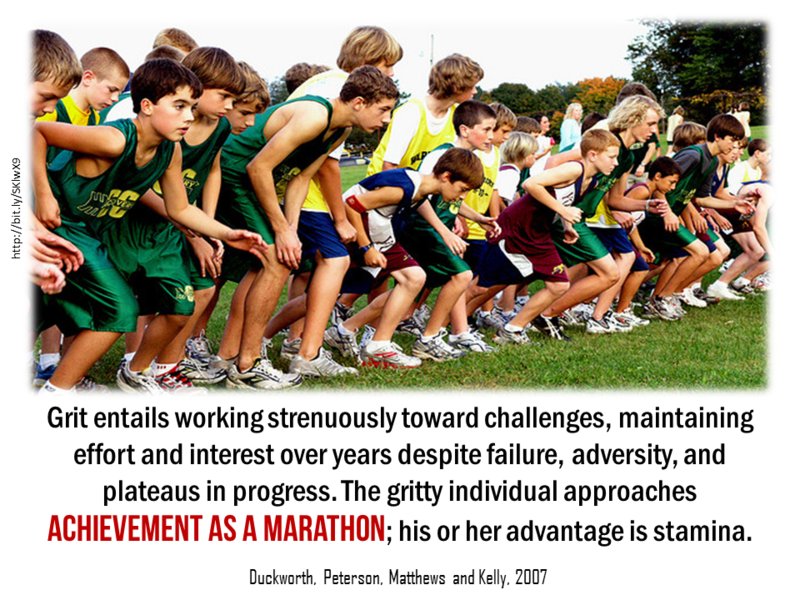
And adults too? Grit as a non cognitive competency --- have educators given serious thought to this? And if we haven't should we? And doesn't grit and resilience apply to our learning too?

I've been thinking on that for a bit ---with five tabs open in my browser that I keep coming back to. And I've been reflecting upon this past year during which I supported coaches in PLP's Connected Learner Experience as they in turn supported learners in becoming more self directed in their own professional learning. One tab, Break Down, Rebuild, Start Fresh speaks to professional learning.  However, most of tabs (DRAFT: Promoting Grit, Tenacity, and Perseverance—Critical Factors for Success in the 21st Century; How to Foster Grit, Tenacity and Perseverance: An Educator’s Guide; Resilience: The Other 21st Century Skills; Grit: The Other 21st Century Skills) are about students being successful as 21st century learners. And I'm feeling they apply to educator professional learning too.

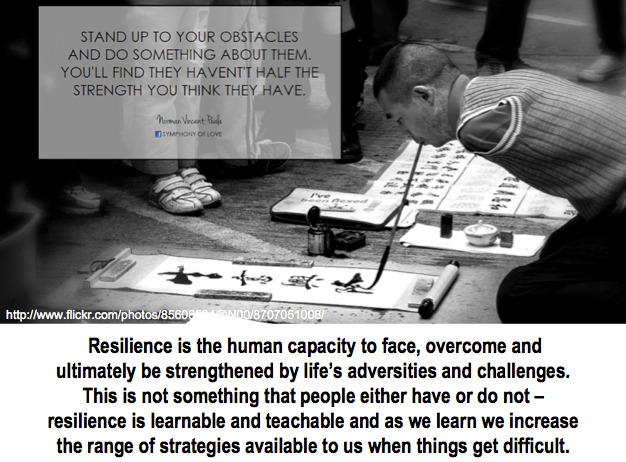
In her post on Grit which included the Duckworth video, Jackie Gerstein  captures the essence of grit:
 and the essence of resilience here:


In her post, she goes on to quote:
"In many cases, particularly with unfamiliar material, educators need to engage students in activities that bridge from their interests and familiar experiences to the learning objectives to help students attain more complex learning goals." (Promoting Grit, Tenacity, and Perseverance—Critical Factors for Success)
 What if just a few words were altered?
In many cases, particularly with unfamiliar material, educators coaches need to engage students educators in activities that bridge from their interests and familiar experiences to the learning objectives to help students  them attain more complex learning goals.
Isn't that similar to this?
Your role as a connected coach will be to deepen the learning experience for those you coach. You will be the bridge from the theory they are hearing to practical application applied in their own personal contexts. Self directed learning is a connection activity. It requires connection to the content and context, to oneself, and to those who are part of the learning community, community of inquiry and the network. (Nussbaum-Beach and Ritter Hall)
And this-- a disposition we've (Sheryl and I) valued for both connected learners and Connected Coaches:
Perseverance toward deep thought by exploring ideas and concepts, rethinking, revising, and continual repacking and unpacking, resisting urges to finish prematurely
Perhaps there is a need to be more specific, to dig deeper with coaches and other connected learners than "perseverance".  For I am convinced-- grit and resilience are non cognitive competencies we as learners (and coaches) need too! So I'm thinking on additional ways that I might support coaches in the coming year-- I'm going to look more closely at the USDOE paper and draw and adapt what may be appropriate for adult learners in creating an environment that enables others to embrace their own grit and resilience. And encourage coaches to be mindful of that also. A work in progress here as I reflect, read, and think some more.

 As Sheryl has exhorted recently:
We’ve let circumstance define who we are and draw boundaries for us that are unnecessary. The means to bring about real shift — to resolve the issues that stand in the way of powerful learning and powerful practice — are found within the collective, collaborative mindset we have inside us.

Taking the posture of a learner first, educator second requires us to understand that we will never arrive at the place of “super educator.” The truth is that even if we solve the problems facing us as a profession, the solutions will only give way to new problems. Now more than ever we need to become the learners we have always wanted our students to be. 
My sense is grit and resilience are a big parts of that mindset she references--  as we each become more self directed in our learning.

Grit and resilience-- competencies, dispositions even more relevant for 21st century adult learners --I'm wondering if it's time for thinking deep on our own strategies and making them more visible to our colleagues and our students?

Tuesday, March 26, 2013

It does!

One of my favorite reads these days is John T. Spencer's edrethink -- so much of what he writes and thinks resonates deeply with me. His post from early February, Age Matters,  has been an open tab on my browser for almost 2 months now and his words ring continue to ring true for me.

This from his final paragraph speaks to me in so many ways and I wanted to share it out loud here:
I believe that children of all ages are capable of deep thinking. I believe that they can shock us with their wisdom and their insight and their knowledge. But I also believe that they are kids. And as kids, they don't think like adults. Not entirely, at least. So, when you ask a fourth grader to identify the key details in a job application or you ask a second grader (who still can't comprehend the size of the sea) to learn longitude and latitude, it's about as absurd as having an open bar in the cafeteria.

Photo credit

Sunday, May 20, 2012

Designing learning through a "multiple paths" lens

As member of a  new community--
Reaching All Students--
Sponsored by ARPDC--

I've been excited and reinvigorated learning so much with these accomplished educators in Alberta.

Their focus and lens on learning speak to me-- reaching all students, designing for learning through a "multiple paths" approach.

Their brief overview video captures how inclusive learning enables every learner to be the best that they can be.


 The student smiles, their words very clearly suggest to me that this is an approach that enables communities of learners in which everyone learns to their strengths.


A member of the UDL group in the wall garden community, I have had the opportunity to renew and deepen my understanding and appreciation for universal design for learning thanks to the contributions of the accomplished educators in this group. A group member shared this interactive website that illustrates the many and varied multiple pathways to learning: http://www.udlwheel.mdonlinegrants.org/ Not only are there options for each principle of multiple pathways but also additional resources for each.

With the availability of these kinds of resources, I'm thinking the support for designing learning experiences that reach all learners can enable incredible possibilities for learning. Just consider the potential-- what if the focus in Alberta, on inclusion, on designing learning through a "multiple pathways" truly became the foundation for learning across our nation? Can you imagine?

Sunday, August 14, 2011

We may never pass this way again--


Not always the biggest of music lovers, Seals & Crofts touch my soul in so many ways.

This melody and these lyrics. have been playing and replaying in my head following a conversation with one of my favorite co learners, Marsha in the Powerful Learning Practice e course Teaching Online where I lamented my lack of participation and what that might mean for my learning and that of others.

As I've been humming to myself all day,
Like Columbus in the olden days, we must gather all our courage.
Sail our ships out on the open sea. Cast away our fears
And all the years will come and go, and take us up, always up.
We may never pass this way again.
It's struck me even more that in our times, this has such a universal call--

To our politicians--
To those who treasure our planet --
To those of us who seek a transformation in education--
To those of us who envision the potential of learning in community--
To those of us learning--

At this moment, we are in unique places--
We can't afford to let any opportunity pass us by--
We may never pass this way again
Of course, this is nothing new--
But there is an urgency in every area--
We are on so many precipices--
Like Columbus in the olden days, we must gather all our courage.
Sail our ships out on the open sea. Cast away our fears
And all the years will come and go, and take us up, always up.
We may never pass this way again.

Wednesday, May 18, 2011

Remembering and Missing--

5th graders in Georgia, affectionately called the Blogicians--

Anne Davis, an accomplished elementary Georgia educator--

Modeling, demonstrating; using podcasts for editing/proofing; holding writing conferences; developing a community of learners--

WordPress blogs--

And an unlikely connection with a Sheppard blogger from Ohio--

Together, connecting, collaborating---

Students and a master educator with content knowledge about writing who developed a 21st century pedagogy enhanced by technology, and connections--

Coming together in a sweet spot that enabled authentic, exciting, sticky learning

Essential ingredients in teaching for learning--

Just imagine a 21st century pedagogy and knowledge of technology; without it the Blogicians likely never would have made the same gains in writing and reading—hear it from Eddie in his own words.

Just imagine teachers competent in designing ways that content was comprehensible for groups of diverse students as Anne so masterfully accomplished.

Just imagine complex, unique blends of technology, pedagogy and content that transform learning much as it did with Anne and her students.

Don’t we need to continue to join in, engage in conversations, nudging, pushing, and if need be, more assertively agitating for these kinds of opportunities for all student learning? Don’t we need to pull in, nudge, and encourage those more reticent, to aspire to and strive for this type of accomplished practice? For Eddie, for all the Blogicians who are now in high school, for all our students?

Friday, February 04, 2011

One drop-- the second in a series

One drop of water helps to swell the oceanphoto © 2009 Ygor Oliveira | more info (via: Wylio)

“Individually, we are one drop. Together, we are an ocean.”
--Ryunosuke Satoro


One drop, then another
We can become an ocean
Changing learning

Second drop (first drop)
Give students choice

From Mr. Chase, a narrative on learning that ended:

The progress came when I remembered what I believe to be true:

  1. Give kids choices. http://autodizactic.com/blog/?p=647
And from Max Fisher who also shares strategies for providing choice to students:
Choice gives them a sense of empowerment over their learning environment. Choice helps keep them engaged. http://www.educationworld.com/a_curr/profdev048.shtml
And from Anna
No matter who comprises our student populations, I am learning that providing choice to those students is crucial. Without the chance to make choices, and the skills and resources that help inform those choices, none of us would have much room to grow. http://www.fromstudiotoclassroom.com/2010/10/learning-to-offer-choices.html
One drop to improve education-- provide choice for all our students-- beginning with little ones, small choices, larger choices -- opportunities to make decisions--

Choice--
Empowering--
Engaging--

If we each begin with this one drop, imagine the ocean--
Imagine changing learning with this one drop--

Monday, June 08, 2009

Bits, Pieces and Questions

Last week—an early morning reading of the New York Times led me to Next Test: Value of $125,000-a-Year Teachers”

-- An article about the new teachers for The Equity Project Charter School that also asked:

“Is a collection of superb teachers enough to make a great school? Are six-figure salaries the way to get them? And just what makes a teacher great?”

Unsettling, not sitting right with me, wondering what learning theory underpins the decisions, wondering about the organizer, about the premise that top money equates with quality educators and about the standards they employ in evaluating great teachers, about the pedagogical beliefs they seek--

Later that day at ASCD,The American Idol* of Education”, some description of the teacher selection process quoted from the TEP website:

“Expert Subject-Area Knowledge demonstrated through

· undergraduate and/or graduate coursework and excellent grades in the relevant subject area

· an original piece of writing on any topic in the subject-area

· a written analysis of a pedagogical issue related to the subject area

Teaching Expertise and Experience demonstrated through

· the submission of TWO of the following three items

· an unedited video clip of a lesson, accompanied by a written narrative that analyzes and reflects upon the teaching and learning that occurs in the lesson

· a portfolio of student work that demonstrates the progress of 2 specific students, accompanied by a written narrative that analyzes the progress that each student demonstrates

· assessment data for at least one entire class of students accompanied by a written narrative that provides background on the assessments and analyzes the data

· the submission of one additional piece of evidence of any form demonstrating student learning

· an essay describing personal pedagogical beliefs and approach

· a day-long teaching audition (either in the candidate’s classroom or in a TEP classroom)

Strong Curriculum Development Ability demonstrated through

· one originally developed and refined curricular tool of any form (e.g. written materials, instructional methodology, technological innovation)

Outstanding Verbal Ability demonstrated through

· the quality of the written work submitted in the application

· communication skills demonstrated in the day-long teaching audition”


My initial reaction-- similar to National Board Certification but-- where are the standards? My personal experience-- those standards explicitly stated a belief in social learning, respect for diversity, and a student centered pedagogy that was expected to be evident in each of the four areas that TEP and research acknowledge are attributes of teacher quality.

For some reason, perhaps this lack of standards and what I believe is a questionable premise for the creation of a school, seemingly missing the point of learning, I couldn’t let this go and looked farther. I wonder how these bits and pieces strike you?


The organizer:

“The school’s founder, Zeke M. Vanderhoek, 32, a Yale graduate who founded a test prep company” --source

Zeke M. Vanderhoek at Zoominfo Under education-- no mention of Yale, just Columbia Teachers College

“Mr. Vanderhoek spent three years teaching at Intermediate School 90 in Washington Heights through Teach for America, which places recent college graduates in challenging schools. He started tutoring to supplement his salary and created a test preparation company called Manhattan GMAT in 2000.” -- source

Teacher selection process:

“There will be telephone and in-person interviews, and applicants will have to submit multiple forms of evidence attesting to their students’ achievement and their own prowess; only those scoring at the 90th percentile in the verbal section of the GRE, GMAT or similar tests need apply. The process will culminate in three live teaching auditions.” --source (emphasis is mine)

TEP, Summer Institute, Sabbatical

“The Equity Project (TEP) Charter School believes that teacher quality is the most important factor in achieving educational equity for low income students.” --source

“Summer institute of 6 weeks teaching challenge: One example of a Teaching Challenge & Tangible Deliverable is as follows: How can technology be maximized to collect student data that informs and improves teaching? Deliverable: Create or identify an exemplary piece of data-collection technology and integrate it into the TEP student and teacher experience.” --source

“Required sabbatical: In addition, TEP teacher sabbaticals are not “sabbaticals” in the usual sense of the word, since they will typically occur every fifth or sixth year, instead of every seventh year. TEP believes that the intensity of the teaching profession mandates a shorter duration between sabbaticals. TEP teachers are expected to begin researching sabbatical opportunities at least one year in advance of their sabbatical year. Teachers may use their sabbatical year for employment (e.g. a position at a think tank), education (e.g. a one-year art-history masters program), or travel (e.g. a travel fellowship). Teachers are not paid by TEP during their sabbatical years; however, TEP attempts to assist teachers in securing funding for their sabbatical-year project.” --source

Hmmmm---------------

Sunday, March 01, 2009

Learning--

PLP, Powerful Learning PracticeSheryl and Will have purposely a designed a professional development model for 21st century learning that is about learning, unlike so many others whose focus is tools. Throughout the life of the Illinois Ohio cohort, they have pushed, nudged, encouraged, and exhorted community members to engage in understanding the shifts inherent in 21st century learning.

Despite incredible growth on the part of so many members, a testing of the waters of “the shift”, some "I get it"s, there has been resistance, push back, notes about all of the “tech activities” and “technology” currently in place, calls for “tools”— Enamored by tools, captivated by technology--

My own personal journey causes me to wonder if community members personal deep beliefs in how people learn have yet been objects of exploration (although there have been many and varied opportunities), resulting in their reluctance to embrace “shifts” that characterize 21st century learning.

Some 11 years ago, having had an incredible opportunity to participate in 40 hours of professional development on unique and compelling uses (publishing, real time data, communication, collaboration) of the Internet in education, I found my students learning skyrocketed when we participated in collaborative projects. At that time, I decided that learning was the result of using the Internet and I wanted to share that with other teachers. I was wrapped up with the use of the tool. I left the classroom to become a resource teacher in the Instructional Technology Office of a large urban district. Over my three years in that position, I reflected upon all I’d done in my classroom and learned as much as I could about learning. I spent hours designing professional development for teachers that modeled good learning with unique and compelling uses of the Internet, realizing that it wasn’t about technology at all, it was about learning and what I believed about how people learn. I returned to the classroom, humbled and eager to design learning experiences with and for my students.

So I know well that understanding the new science of learning is important and hard work, yet it’s not new.

From How People Learn: Brain, Mind, Experience, and School: Expanded Edition 1990
An emphasis on understanding leads to one of the primary characteristics of the new science of learning: its focus on the processes of knowing (e.g., Piaget, 1978; Vygotsky, 1978). 10

Asking which teaching technique is best is analogous to asking which tool is best—a hammer, a screwdriver, a knife, or pliers. In teaching as in carpentry, the selection of tools depends on the task at hand and the materials one is working with
If, instead, the point of departure is a core set of learning principles, then the selection of teaching strategies (mediated, of course, by subject matter, grade level, and desired outcome) can be purposeful. The many possibilities then become a rich set of opportunities from which a teacher constructs an instructional program rather than a chaos of competing alternatives. 23

Learning is influenced in fundamental ways by the context in which it takes place. A community-centered approach requires the development of norms for the classroom and school, as well as connections to the outside world, that support core learning values.

Teachers must attend to designing classroom activities and helping students organize their work in ways that promote the kind of intellectual camaraderie and the attitudes toward learning that build a sense of community. In such a community, students might help one another solve problems by building on each other’s knowledge, asking questions to clarify explanations, and suggesting avenues that would move the group toward its goal (Brown and Campione, 1994). Both cooperation in problem solving (Evans, 1989; Newstead and Evans, 1995) and argumentation (Goldman, 1994; Habermas, 1990; Kuhn, 1991; Moshman, 1995a, 1995b; Salmon and Zeitz, 1995; Youniss and Damon, 1992) among students in such an intellectual community enhance cognitive development.

Teachers must be enabled and encouraged to establish a community of learners among themselves (Lave and Wegner, 1991). These communities can build a sense of comfort with questioning rather than knowing the answer and can develop a model of creating new ideas that build on the contributions of individual members. They can engender a sense of the excitement of learning that is then transferred to the classroom, conferring a sense of ownership of new ideas as they apply to theory and practice. 25
Adapting new theories of learning are even more challenging yet needed.
From George Siemens Connectivism: Learning Theory or Pastime of the Self-Amused? 2006
We are growing in our understanding of learning. Research in neuroscience, theories of social-based learning, and developments in learning psychology create new understanding of the act, and process, of learning.

As Downes (2006) stated,
Learning…occurs in communities, where the practice of learning is the participation in the community. A learning activity is, in essence, a conversation undertaken between the learner and other members of the community. This conversation, in the web 2.0 era, consists not only of words but of images, video, multimedia and more. This conversation forms a rich tapestry of resources, dynamic and interconnected, created not only by experts but by all members of the community, including learners.

Of most importance is that educators are reflecting on how learning has changed and the accompanying implications of how we design the spaces and structures of learning today.
My journey, my evolving practice and changing beliefs about learning-- from behaviorism with task based learning, to cognitivism with clear objectives and problem solving, to constructivism with social learning and knowledge construction by each learner, to conectivism with complex, open, autonomous, distributed learning -- was long, was arduous, was essential. I’d like to think that evolution reflects my ever increasing understanding of the new science of learning and the recognition of the new opportunities for learning afforded by today’s emerging technologies. Yet, today there is more urgency, a greater need to make a great leap to connected networked learning -- to provide appropriate learning experiences for our children in today's world.

Sheryl and Will, with PLP, provide the perfect environment for deep reflection, for introspection into beliefs about learning, for meaningful conversations about learning in community, for making that great leap. It is my fervent hope that reluctant community members will engage and immerse in those types of reflection and conversation, will move beyond the “tools”, will not let such an opportunity to make practice more relevant, more authentic whoosh right by—

Mindful of my own journey, mindful of the possibilities of 21st century learning, ever mindful of my role as community leader, I move beyond hope to continue to encourage, to nudge, to push--